Hot off the e-presses, I am happy to share this online magazine titled Progress…
My work is featured on pages 5, 16, & 17. Also included is work by artist Amanda Kiesling, a feature article on Ayla Rexroth’s Subterranean Gallery, and a brief history of Pitch Magazine, a KC staple for local arts and culture.
The day before the election, I was giving my own version of a stump speech, detailing my origins as an artist, from my early to present work, and touched on my upcoming projects.
Muchos thanks to fellow artist and Inspiration Grant winner Angelica Sandoval for letting me use the awesome Kickstarter Shout-Out she made for me as the title slide of my presentation (Her Kickster was successful too! You can see her installation now in the windows of BNIM in downtown KC). Sooo much better than plain ol’ text. I love it.
I was able to cover my early work, including this piece In the Eye of the Beholder.
Of course, I went over the process of making my current work and my studies at the Anderson Ranch Arts Center.
I aim to please, so I also brought finished work as well as many random samples and experiments from the studio.
Thanks to Leslie at the Kauffman Foundation for hosting me and to the Metro Arts Council for running the Now Showing Program! I enjoy sharing my work and hope to do so again. Yay for public speaking!
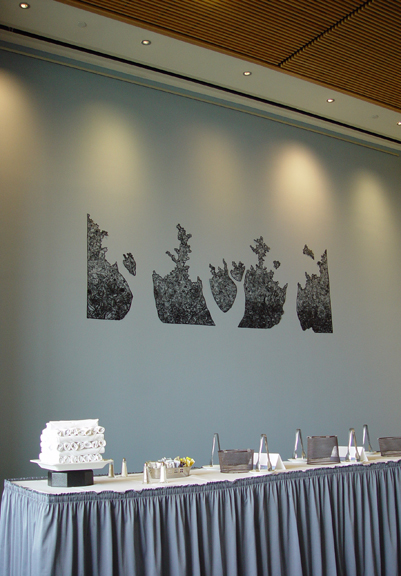
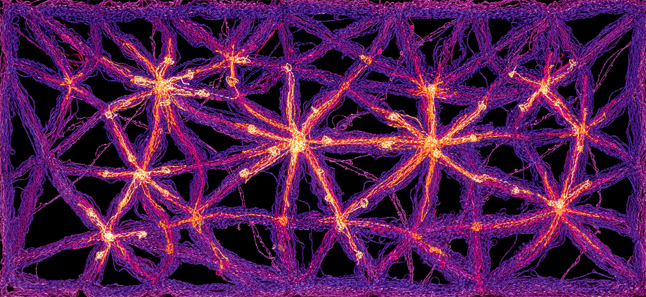
A year in the making, the Superclusters are now on display at the Missouri Bank Crossroads Artboards at the intersection of Wyandotte and Southwest Blvd. Google Map. The images face west.
I am an amatuer space nerd, with the appropriate nerd crushes on the likes of Carl Sagan and Neal deGrasse Tyson. It is also immensely difficult to step back from the never-ending bombardment of minutue in our daily lives and bask in the knowledge that we are a part of a mind-boggling universe, so vast, mysterious and amazing that our jaws should be perpetually dropped. It is not a separate thing. It is us. We are in and of it. We are vast.
These images are dedicated to that wonder. They are representations of galactic superclusters, the largest known structure in the observable universe. Matter does not evenly disperse. Galaxies cluster together in sheets and filaments. The galaxy clusters then also cluster into a larger structure, hence a supercluster. Our Milky Way is in the Local Group of galaxies, which is a part of the Local, or Virgo, Supercluster.
Photo by NASA
This commission was awarded in 2011, which is also when the US dismantled it’s space shuttle program. In the same year, the Tevatron, once the world’s most powerful particle accelerator, was shut down. Many of the advances in technology and in our daily lives originated in space exploration research and development, so I am saddened by the loss of interest and funding in these areas on a national level. So I thought science needed a bit of advertising!
These should be up through January, so I hope you get a chance to take a look when you’re downtown!
If you’re getting anxious about the election, I would be honored to distract you with arty goodness! So before you vote on Tuesday, take some of the ‘ick’ out of Monday.
Just bring your lunch to the Kauffman Conference Center on Monday, November 5th at High Noon. I will do my utmost to regale you with my driving passion, the life-blood that keeps me going — or more humbly stated, I will give a presentation on my work.
The talk will cover a short retrospective on past work, as well as looking at the experimental processes and materials of present work (Exactly how does a student of architecture end up spending untold hours sewing lace?). I’ll also cover ongoing and upcoming projects with time for Q&A. I will also have a few work samples and experiments on hand for a bit of “show and tell.” If time and space allow, we might be able to get in a short walking tour of the works on display in the Conference Center after everyone has finished munching!
This is my first public talk in quite a while, so I’m very excited for this opportunity and I would love to see you there!
Lunch & Learn Artist Lecture – Rachelle Gardner
Monday, November 5th, 12 – 1pm
Ewing Marion Kauffman Foundation Conference Center Brookside Room
4801 Rockhill Road
Kansas City MO 64110-2046
This exhibition and lecture is possible through the Now Showing Program. Many thanks to the staff at the Arts Council of Metropolitan Kansas City for their unwavering support of local artists through the Now Showing Program and, of course, big thanks to the Ewing Marion Kauffman Foundation for participating!
P.S. Some day I have to do a post on these guys – Stakeclaimers. I love the texture.
I was very excited to learn this week that two of my pieces have been accepted into Fiberart International 2013. Sponsored by the Fiberarts Guild of Pittsburgh, these works could tour to different venues for up to two years. The first venue on the roster will be the San Jose Museum of Quilts and Textiles (in addition to Pittsburgh, I assume). Jurors chose 81 pieces by 64 artists out of 1,200 works of art by 525 artists from 36 countries. So getting two pieces accepted is nice big shot in the arm.
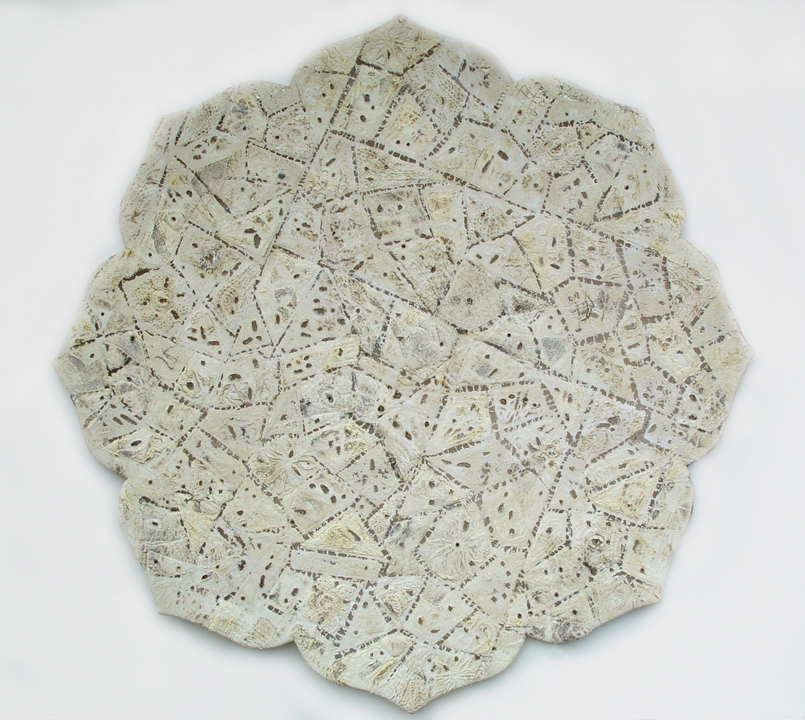
The chosen works? Revealing Cracks Mandala, which has ehxibited in the 55th Chautauqua Exhibition of Contemporary Art in New York, received Honorable Mention at the Leawood Foundation Arti Gras Exhibition, and is currently on display at the Kauffman Foundation Conference Center in Kansas City. So if you are in the KC area and haven’t seen this piece, drop by before December, because this puppy will be gone for a long time. I will be announcing a date for a Lunch & Learn presentation at the Kauffman Conference Center very soon, which will give you a last opportunity to see this work for quite a while and also hear about what I’ve been up to!
The other lucky traveler? Unable to Divide, recently back from Baltimore.
Because of the lengthy touring schedule, the call for artists only goes out every three years. Check out works from the 2010 show here: http://fiberartinternational.org/exhibits
I have been so busy that it’s hard to even decide what to write for this post. I should backtrack…
The Kickstarter Campaign was successful. Wooo!! After finding that out, I immediately had to race out to Aspen, CO and The Anderson Ranch Arts Center for my course in Soft Sculpture.
Aspen…yes. Beautiful, amazing, and of course, depressing to leave. Time flew. While it did fit in a smidge of site-seeing and one good hike, most of that time was spent in the studio – a beautiful and well-lit loft space.
A few of my studio cohorts! Such a wonderful crew!
Our teacher, Lynn Richardson was (and I’m sure still is) fantastic. She had the great attitude of, “Yeah! Let’s make this!” Exploration and invention was definitely encouraged. Here’s some of her fabric sculpture…
Red State by Lynn Richardson 2005 vinyl, nylon, steel, lights 20′ x 20′ x 18′
On that note, I’ll just start posting some of my experiments of combining casting resins and lace or other fabrics.
Cast paper lace. This was a tricky little mold to make, but I enjoyed the crystalline results when backlit. So much so, a studio cohort even helped me shoot a few videos of it spinning in light. There’s no thread in it (just bits of paper), but hey, it’s definitely lace! I am currently making a series of these in black. Small individually, they could fill a wall and look delicious.
This is a hanging onion orb, if you will, using only red organza. I recently tried casting one in my own lace, but learned the hard way that I must use clear tints when using my lace – ope!
I donated this little piece to the Art Center’s Auctionette, where I heard it was happily snapped up. This is 100% cotton cast in red-tinted resin. I am currently trying my hand at this technique to make a lace bowl. I hope to get it cast this weekend (fingers crossed).
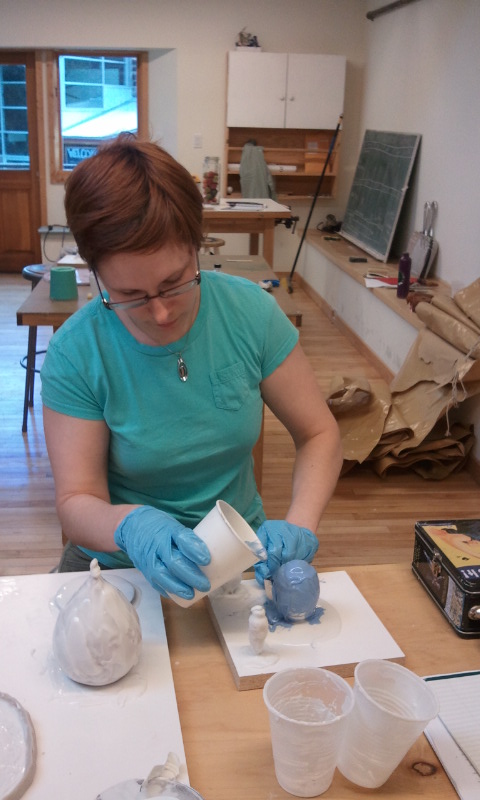
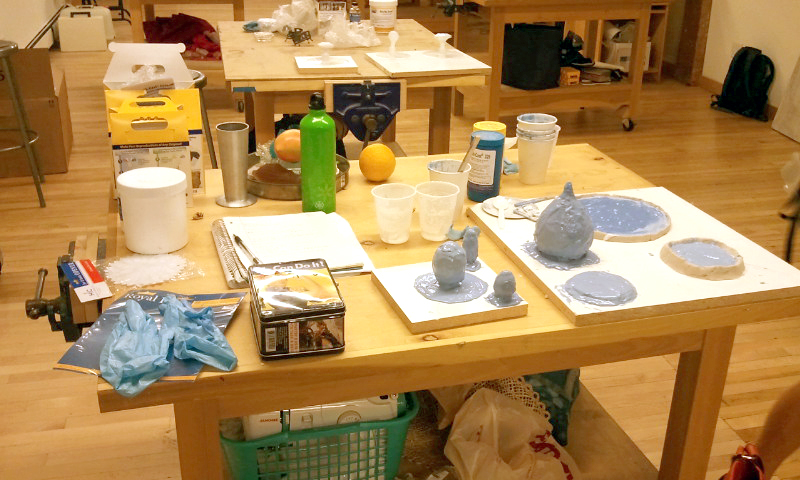
Here are a few more studio shots of building the molds and mother molds.
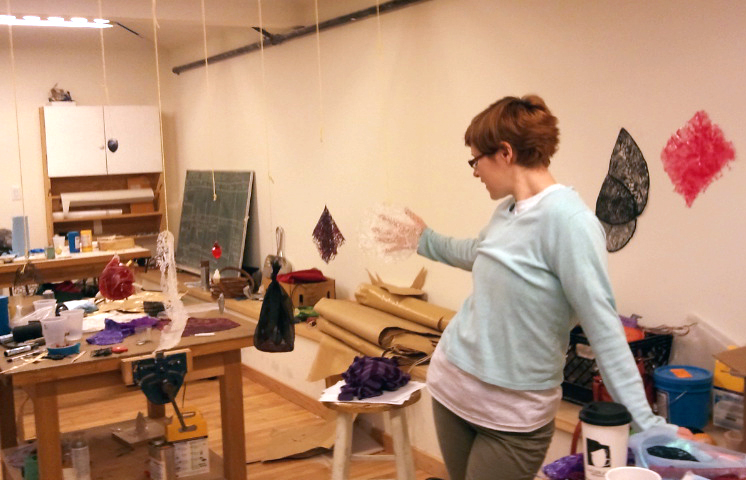
And finally here I am examining my experiments. I suspended all my little tests so by the end of the week I had a curtain of randomness behind me. I also cast a few fishing bobbers and had some fun little results (the intent is to work with the media on a larger scale, but for the workshop I worked on a small scale to conserve materials and make as many experiments as possible). But I’ll save that for later!
After a somewhat treacherous trip through the mountains at night in rain and fog, Aspen revealed itself as a safe haven! After some much needed sleep, today I got my bearings and went over to the arts center to drop off supplies and check out the campus. A pre-workshop dinner and faculty lectures are scheduled for tonight. Excited to meet my classmates and teachers! Then tomorrow morning, we start in full swing!
Billboards are typically utilized as a way of advertising commercial products or services on a large scale. Playing on this idea, these images for the Missouri Bank Art Boards (Fall 2012) represent the largest structures in the universe presently known to mankind. In a time filled with economic gloom, where one debt crisis after another rises to the surface of our attention, it is easy to lose perspective on the true scale of things. Perhaps a reminder is in order for what constitutes a big deal on a universal level and the biggest deal of all is, in fact, galaxy superclusters.
Galaxies cluster together due to gravity, and then these groups of galaxies also cluster on an even larger scale into sheets and filaments, creating galaxy superclusters (incidentally, our little galaxy makes its home in the Virgo Supercluster).
In this representation of galaxy superclusters, materials and process are as important as the image itself. The filament-like nature of images of superclusters is represented by threads. A web of delicate threads is created by using a film that stabilizes the threads while sewing. The film is later dissolved (to a degree in other works), leaving voids. Incidentally, astronomers theorize that the voids between galaxy superclusters may not be empty, but home to mysterious dark matter. The use and removal of the film acknowledges a structure that exists but is invisible.
This submission also plays into a subject that needs advertising with the American youth: science. From the United States ending the NASA shuttle program this summer, depending on Russia to get American astronauts off the ground to the 2011 shut down of the Tevatron, the once awesome particle accelerator near Chicago that is now obsolete due to Europe’s Large Hadron Collider, our country is falling behind in scientific innovation.
Woefully behind in blogging, yes. 2011 was a tumultuous year. But moving on, here’s the latest work: Can’t See the Forest for the Trees. 3×9′ (yes, feet) of cotton & polyester thread (Gütermann) and pins (but not as many pins as you’d think). From initial concept to finished work, this took about two months. I hope to post about the process within the week.
Process is integral to my work and often becomes intertwined with concept as in Can’t See the Forest for the Trees. It is essentially about being lost, about losing perspective (literally or metaphysically) based on one’s position in time and space and how subjective clarity can be.
As such, every detail of the forest was meticulously drawn and stitched with varying degrees of density. Through a finishing process, details closest to the forest floor stay relatively clear. Moving upward, details become fuzzy until we reach the canopy where many details dissolve into abstraction.
A significant part of its making is the fact that part of the work itself was lost in its manifestation. Even the viewer’s interaction with the piece is determined by the viewer’s relative position to the work.
It is the constant play between being able to see the details and the (often elusive) big picture, whatever that picture may be.
Seen individually, the thread structures form random shapes. Many details become visible up close, but the shapes have little meaning unless seen from a “big picture” perspective.
work in progress - pit-fired shell form - felting will be used to complete piece
Here are a few of my favorite results from my first attempt at pit firing ceramics. As experiments, they are all fairly small, the longest of these is about six inches. Not everything came out on the first try, but the best ones almost look like stones. I hope to have some images of the pit firing event itself soonish. For context, these “shells” (they are hollow or cup-like) are intended to be the bases of sorts for felting sculpture. Or so the idea currently stands…
Process: All pieces are slip-cast earthenware. Various surface techniques, such as burnishing, buffing, oiling, and terra siglatta were used in the greenware stage. They were then bisque fired in an electric kiln. Some pieces then received additional surface work. For the pit firing, various chemicals were added on and near the pieces for coloration, including rock salt, red iron oxide, copper carbonate, manganese dioxide, and cobalt oxide. The speckling in these pieces are a result of the various chemicals.
work in progress - ceramic pit-fired shell formone of my favorites - slip cast pit-fired earthenware

 Muchos thanks to fellow artist and Inspiration Grant winner